

Mastercard Economics Institute’s 2026 Economic Outlook for MENA: Robust growth underpinned by investment and digital transformation
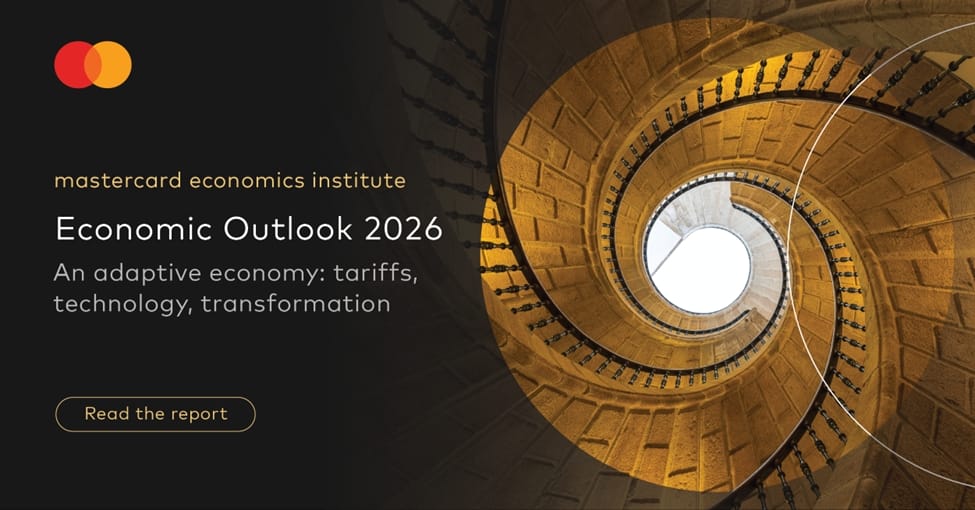
- MENA region’s GDP is projected to rise by 3.6% year on year, compared to global GDP growth of 3.1%
- AI adoption and fiscal expansion will be critical factors to watch
- Trade continues to shift towards emerging markets
- SMEs are increasing their digital presence
Cairo, Egypt: The Mastercard Economics Institute released ‘Economic Outlook 2026’, its annual report identifying the themes that will shape next year’s economic landscape. The report anticipates policy changes that grabbed headlines in 2025, to exert their force on economies around the world throughout 2026. While the acceleration in global fragmentation presents challenges, increasing AI adoption presents opportunities.
In 2026, the Mastercard Economics Institute expects global GDP growth to moderate to 3.1% but anticipates MENA GDP to rise by 3.6% year on year (YoY), though rates will be uneven across the region. The growth trajectory is projected to be the strongest in Qatar at 4.9%, driven by higher liquified natural gas (LNG) production, followed by Egypt with 4.4%. In the UAE and Saudi Arabia, GDP is forecast to increase by 4.3% and 3.6% respectively although non-oil GDP is expected to be stronger at close to 5% in both countries. Pakistan is expected to grow 3.6% next year. Other GCC markets with their anticipated growth rates for 2026 are Oman (3.3%), Bahrain (3.1%) and Kuwait (2.5%). Public sector investment and resilient consumption will underpin economic activity across the region.
Inflation should remain stable at around 2% in the GCC and slow to an average of 6.7% in oil-importing economies. Disinflation, aided by a weaker US dollar and lower energy prices, may allow central banks to reduce rates, easing cost-of-living pressures.
“Looking ahead to 2026, the economic forecast for the MENA region appears broadly favorable, driven in part by ongoing structural reforms. For oil-exporting countries, easing financial conditions will likely stimulate non-oil sectors, as interest rates decrease alongside rate cuts in the US. Reduced borrowing costs and controlled inflation are expected to benefit consumers, spurring demand across key sectors such as real estate, tourism, and retail. There are risks to the outlook however, including geopolitical tensions and climate-related challenges, which may disrupt investment and economic activity,” said Khatija Haque, chief economist, EEMEA, Mastercard Economics Institute.
Key findings from the report include:
Investment remains a key driver of growth
GCC countries are channeling substantial resources into renewables, construction and technology, reshaping global supply chains and capital flows. In line with long-term national visions like Saudi Arabia’s Vision 2030, these investments are expected to support non-oil growth, advancing economic diversification, creating jobs and attracting talent to the region. Meanwhile, oil importers are seeking foreign direct investment (FDI), particularly in renewable energy. Egypt has seen substantial investment in green hydrogen and solar power, capitalizing on its favorable geography and climate.
Diversifying trade with emerging markets
Though higher tariffs and elevated geopolitical tension remain threats, trade in the MENA region has been gradually shifting away from advanced economies toward other countries within the EEMEA (Eastern Europe, Middle East, Africa) region as well as other emerging markets over the past two decades.
Digital transformation and fiscal expansion among main tailwinds
The Mastercard Economics Institute anticipates digital transformation, particularly deeper AI integration, will boost productivity and growth. The Middle East is expanding through major investments and digital infrastructure primarily driven by long term strategies such as Saudi Arabia Vision 2030 and The UAE National Strategy for Artificial Intelligence 2031.
SMEs remain vital to the region’s economy
Digital tools are increasingly enabling small businesses to streamline operations, reduce costs and compete more effectively. But the digitalization of SMEs is not uniform across the globe. MEI has measured both the SME share of retail spending and the growth in the share that is online. In the UAE SMEs make up just over 37% of retail spending and the share of ecommerce spending at SMEs has grown year-on-year.
To succeed, SMEs require strategic agility and digital readiness. Those that are the most flexible and tech forward are likely to be best positioned to accelerate growth. MEI sees an opportunity for SMEs to continue to gain share in tech-driven services. There is a growing demand for local tech solutions and a more specialized offering. This expansion into high-value services suggests that SMEs can compete more effectively in sectors traditionally dominated by larger firms.
Consumers worldwide will remain savvy, focusing on international, tech-enabled and value-conscious spending. They will continue to prioritize meaningful moments, such as travel and live events, while remaining price-sensitive for many necessary goods.
The ‘Economic Outlook 2026’ report draws on a multitude of public and proprietary data sets, including aggregated and anonymized Mastercard sales activity, as well as models that are intended to estimate economic activity.

Related Posts




Recommended Stories






Chief Marketing Officers Magazine (CMOs) is Egypt's first printed and digital publication in both Arabic and English for Marketing, Media and PR Professionals with news, articles and commentary on the industry.